Geology · Painting · Public engagement

Stone reveals time. Art makes it visible.

Geologist, concept developer and artist Torsten Schönberg originated the idea of translating geological investigation into art. Together with his father, the painter Dieter Schönberg, he developed “Petrographie – Stein-Zeit in der Kunst” (“Petrography – Stone-Time in Art”), a project that moves from fieldwork and microscope to canvas, exhibition and conversation.

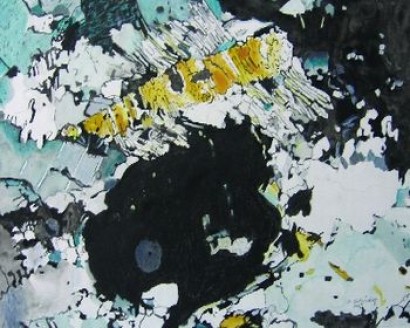
Petrographic painting based on Gföhl gneiss from the Waldviertel region
Gföhl gneiss · Waldviertel, Austria

The concept

Science is part of the artistic process.

A rock sample is not merely represented. Its origin, preparation and petrographic analysis remain part of the work.

Most of the thin sections used in the project were prepared in the course of Torsten Schönberg’s geology diploma thesis. The scientific material thus became the direct basis of an artistic method.

Torsten Schönberg selects and locates metamorphic and igneous rocks. Thin sections reveal minerals, fabrics and internal structures under polarised light. These microscopic views become the starting point for selection, composition and painting.

Dieter Schönberg translated the scientifically obtained material into autonomous paintings. Scale, colour and rhythm no longer serve as illustration alone: they create a second way of reading the same material.

The project therefore links four fields: scientific knowledge, artistic translation, accessible communication and social dialogue about nature, time and perception.

The connection to Joseph Beuys

A biographical point of departure.

Torsten and Dieter Schönberg saw Joseph Beuys and his art during their shared visits to documenta in Kassel in 1977 and 1982. In 1987 they returned to documenta specifically because of “7000 Oaks”; Beuys had already died by then and the project was completed beyond his lifetime.

Beuys’ expanded concept of art became a personal inspiration. Each of 7,000 trees was paired with a basalt stone, while the initial stockpile of stones on Friedrichsplatz diminished with every planting. Material, time, action and urban society became connected.

Torsten subsequently developed an independent approach. Thin sections of metamorphic and igneous rocks were examined under the microscope; their hidden structures became source material for art and painting. Exhibition, film and discussion return the result to the public sphere.

There was no collaboration, authorisation or institutional affiliation with Joseph Beuys or his estate. The connection described here is personal, biographical and conceptual.

Historical context: documenta 6 (1977) · documenta 7 (1982) · documenta 8 (1987)

From rock to image

A traceable transformation.

The scientific origin stays visible even when a painting develops its own visual language.

01

Field and map

Samples are collected, located and assigned to a geological context.

02

Thin section and microscope

Polarised light reveals mineral composition, fabric and optical structures.

03

Art and exhibition

Selection and painting lead to a public presentation with film, maps and context.

A shared project continues

Memory is not a full stop.

Dieter Schönberg died on 15 July 2024. His paintings and his contribution remain a formative part of the project.

Torsten Schönberg preserves the existing body of work and continues its scientific and artistic approach. He is the contact for exhibitions, press, collaborations and information about the works.